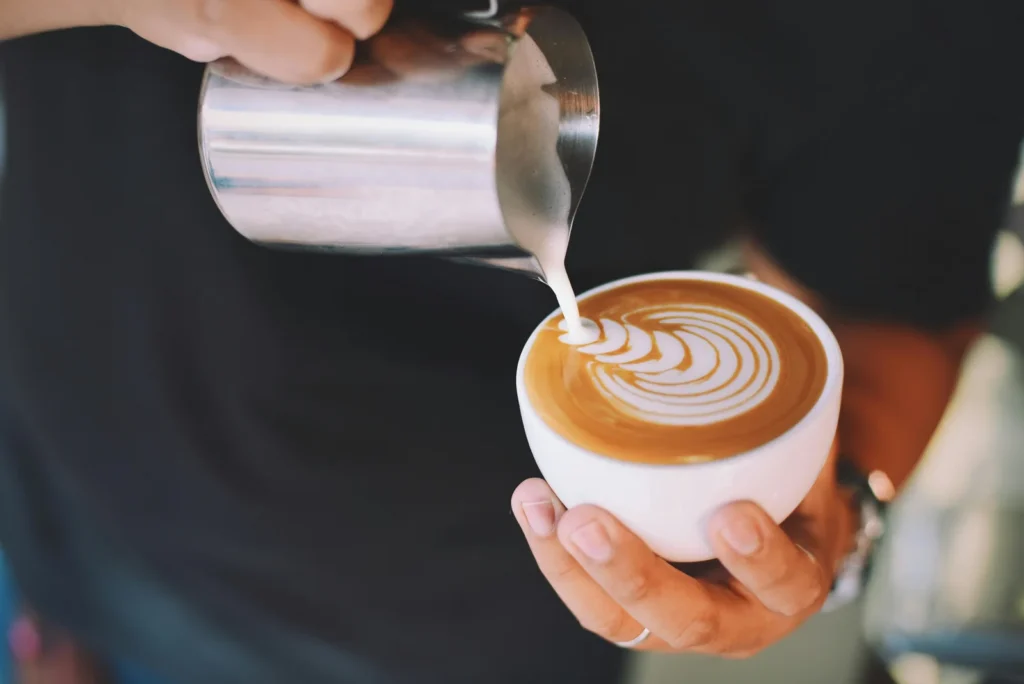
The pumpkin latte may look like a simple seasonal indulgence, but behind the counter, America’s coffee business is becoming increasingly sophisticated.
A new study examining 110 seasonal drinks from some of America’s largest coffee chains found beverages containing close to 300 milligrams of caffeine in a standard serving—and as much as 400 milligrams when customers order the largest available size.
For Vinnie Lisi, CEO of Espresso Mio, the findings illustrate a larger transformation taking place across the commercial coffee industry.
Consumers aren’t simply expecting better coffee anymore. They’re expecting complicated beverages delivered quickly, consistently and with very little tolerance for mistakes.
And that is changing the technology required to serve them.
Nearly 300 Milligrams in a Standard Fall Coffee
Research from Sage Space Technologies analyzed fall 2026 menus from Starbucks, Dunkin’, Dutch Bros, Caribou Coffee, Tim Hortons, BIGGBY Coffee and PJ’s Coffee, examining caffeine levels across seasonal beverages.
Dunkin’s medium Nutty Pumpkin Iced Coffee ranked highest at an estimated 297 mg of caffeine. Caribou Coffee’s medium Pumpkin Espresso Shaker followed with 295 mg, while Starbucks’ Grande Iced Pumpkin Cream Shaken Espresso contained 255 mg.
Those figures become even more striking when customers size up.
Two XL Caribou Coffee seasonal energy drinks contained 400 mg. Dunkin’s large Nutty Pumpkin Iced Coffee was estimated at 396 mg, while its large Pumpkin Pie Coffee Chiller was estimated at 393 mg.
The research also modeled how long caffeine could remain in the body.
Assuming an 11 p.m. bedtime and a five-hour average caffeine half-life, the researchers calculated the latest time each beverage could be finished for residual caffeine to fall below 30 mg by bedtime. The study stresses that this is a modeling threshold—not a universal medical or safety limit—and that caffeine metabolism varies considerably among individuals.
Even with those limitations, the numbers demonstrate how powerful today’s coffee beverages can be.
For Lisi, however, there’s another side of the story.
Someone has to produce all of those drinks.
From Coffee Shop to Beverage Production System
Lisi has spent decades around commercial coffee equipment.
Espresso Mio, the family-owned commercial espresso company he leads, serves businesses throughout New Jersey and New York, providing equipment support, installation, preventative maintenance, cleaning, calibration and emergency repairs.
What Lisi has watched happen to the industry is significant.
The traditional coffee shop was largely built around relatively straightforward beverages: coffee, espresso, cappuccino and latte.
Today’s customer can expect multiple espresso shots, different milk choices, flavored syrups, cold foam, temperature customization and iced or blended preparations—all while expecting the order to be produced within minutes.
That creates an operational challenge.
“Customers see the finished drink. The operator sees everything that has to happen behind the counter to make that drink correctly hundreds of times,” says Lisi.
That distinction is becoming increasingly important.
A successful coffee program is no longer simply about buying quality beans and hiring someone who knows how to pull an espresso shot.
It’s increasingly a technology and systems business.
Why Super-Automatic Espresso Machines Are Growing in Importance
One technology positioned particularly well for that environment is the commercial super-automatic espresso machine.
Traditional espresso preparation requires several individual steps and considerable operator skill. Grinding, dosing, tamping and extraction all introduce opportunities for variation.
Super-automatic systems automate many of those functions and can allow businesses to program recipes and reproduce them consistently.
That can be particularly valuable in operations where numerous employees use the same machine.
A highly trained barista may be able to produce an exceptional espresso manually.
But a restaurant with dozens of servers, a hotel operating multiple shifts or a high-volume café has a different challenge: How do you reproduce that beverage hundreds of times regardless of who is working?
“Consistency is one of the biggest things operators underestimate,” says Lisi. “If five different employees are making the same drink, the customer shouldn’t get five different versions of it.”
What Starbucks’ Equipment Strategy Can Teach Independent Operators
One company that has long understood the connection between equipment and consistency is Starbucks.
Its relationship with Swiss commercial coffee-equipment manufacturer Thermoplan has made the manufacturer particularly recognizable within the super-automatic category.
For Lisi, who has extensive experience working with commercial coffee equipment including Thermoplan systems, the significance isn’t simply that a global coffee company uses sophisticated machinery.
It’s what the strategy represents.
A company operating at massive scale cannot depend entirely upon individual employee technique to reproduce its core beverages.
It needs systems.
Independent cafés, restaurants and hospitality operators face the same fundamental problem—just at a smaller scale.
“You’re trying to remove unnecessary variables,” Lisi explains. “The equipment should help the operator deliver the same product on Monday morning that they deliver on Saturday night.”
The Machine Is Only Half the Equation
There is another lesson Lisi believes operators need to understand.
The more sophisticated commercial coffee equipment becomes, the more important service and preventative maintenance become.
An espresso machine might represent a substantial capital investment, but its true value comes from the revenue it helps generate.
When that machine stops operating during breakfast, lunch or dinner service, the cost isn’t limited to the repair.
Every drink that can’t be sold represents lost revenue.
That is why Espresso Mio emphasizes preventative maintenance, cleaning, grinder calibration and access to emergency commercial repair.
Waiting until a machine completely fails can be an expensive strategy.
Scale magnifies the issue.
A location selling 20 espresso beverages per day has one level of exposure. A high-volume restaurant, café, hotel or convenience operation selling hundreds has another.
Lisi Says Operators Should Ask Different Questions
When businesses contact Espresso Mio about commercial equipment, Lisi encourages them to think beyond the purchase price.
How many drinks will the operation produce during its busiest hour?
What percentage will be milk-based?
How many employees will operate the machine?
How much training will those employees realistically receive?
How quickly can the equipment be cleaned?
How difficult is it to obtain replacement parts?
And perhaps most importantly:
Who is going to fix it when it stops working?
“People spend a lot of time researching which machine to buy,” Lisi says. “They should spend just as much time thinking about how they’re going to keep that machine running.”
America’s Coffee Expectations Are Changing
The Sage Space Technologies research provides an unusual window into just how far the modern coffee beverage has evolved.
Of the 110 drinks analyzed, 48 fell into the study’s “morning only” category, meaning their modeled caffeine cut-off occurred before noon.
The researchers cautioned against treating the calculated times as strict individual rules. Gabriel Ettenson, founder and COO of Sage Space Technologies, noted that caffeine sensitivity varies and suggested that consumers concerned about sleep experiment with earlier cut-off times, smaller sizes, fewer espresso shots or decaffeinated alternatives.
For the commercial coffee industry, however, the study highlights something else.
Coffee is no longer just coffee.
It has become a highly customizable beverage platform encompassing espresso, cold brew, energy drinks, milk, foam, flavoring and seasonal products.
As the beverages become more sophisticated, Lisi believes the infrastructure required to produce them will have to become more sophisticated as well.
That could make super-automatic machines, intelligent equipment and specialized commercial service increasingly important for independent operators trying to compete with national chains.
For Lisi, though, the objective remains surprisingly simple.
“The technology is there to make the operation easier,” he says. “At the end of the day, the customer just wants a great cup of coffee.”
And increasingly, delivering that simple experience requires some very sophisticated equipment behind the counter.
About Vinnie Lisi and Espresso Mio
Vinnie Lisi is CEO of Espresso Mio, a family-owned commercial espresso equipment company serving New Jersey and New York. With roots in commercial espresso machine repair stretching back more than 40 years, Espresso Mio provides commercial equipment installation, preventative maintenance, emergency repair, cleaning, grinder calibration and support for sophisticated super-automatic systems, including Thermoplan equipment. Study source: https://sagespacetechnologies.com/