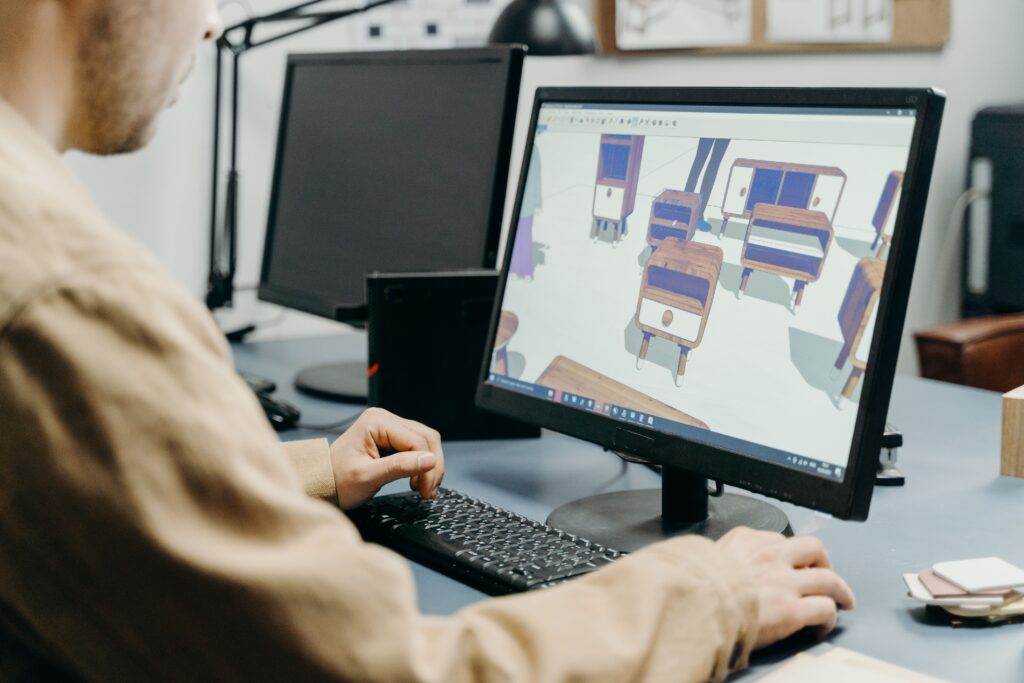
A photorealistic rendering is a computer-generated image of a product that looks like a photograph of an object that does not physically exist yet. For an inventor deciding how to present an idea, the rendering is usually the first thing a potential licensee sees, and it often decides whether the conversation continues. That is why so many product pitches now open with a set of realistic images instead of a hand-built sample.
What a rendering actually is
A rendering starts with a three-dimensional digital model built in design software. An artist assigns materials, colors, textures, and lighting to that model, then the software calculates how light would fall across every surface. The result is a still image, or a short animation, that reads as a real product photo. The same digital file can produce a dozen angles, several color options, and a packaging mockup without anyone cutting a single piece of plastic.
This matters because the alternative, building a physical sample for every design variation, is slow and expensive. A digital model can be revised in an afternoon. A tooled physical part cannot.
Renderings are not patent drawings
People new to inventing often confuse the two, but they serve different masters. A patent drawing is a legal document. The U.S. Patent and Trademark Office sets strict formatting rules for it, including line work, specific margins, and numbered reference characters, as described in the agency’s patent guidance at uspto.gov. Those drawings define and illustrate the claimed invention for examination. They are deliberately plain.
A rendering does the opposite job. It sells. It shows a buyer what the finished product would look like on a shelf, in a hand, or in a kitchen. One is built for a patent examiner. The other is built for a purchasing manager. An inventor generally needs both, and they come from different processes for different audiences.
Why companies respond to renderings
A licensing decision is a business decision. The person across the table is trying to picture the product in their catalog and estimate what it would take to make and sell it. A clean set of renderings answers a stack of silent questions at once: What does it look like? How big is it? Which materials read as premium or budget? How would it photograph for a website? A rough sketch leaves those questions open. A realistic image closes them.
There is also a credibility signal. Professional visualization tells a prospective partner that the inventor took the idea seriously and invested in presenting it clearly. That does not promise a deal, but it changes the tone of the first meeting.
The virtual-first path
For years the assumption was that an inventor needed a working physical prototype before approaching anyone. That assumption has weakened. Many companies now evaluate ideas from renderings, computer-aided design files, and animation, then ask for a physical sample only if the idea advances. The visual package carries the early conversation.
Firms that specialize in this work treat renderings as a core deliverable rather than an afterthought. The discipline behind them, shaping a product so it looks right and works right, is the industrial design work that turns a rough concept into a product a buyer can picture. Enhance Innovations, a product development firm in Champlin, Minnesota that has operated since 2010, builds these virtual prototype packages as its standard first deliverable, with physical models scoped only when a specific project calls for one.
What good visualization requires
Three things separate a convincing rendering from a flat one. First, an accurate model, because lighting cannot hide bad geometry. Second, correct materials, since the difference between brushed aluminum and painted plastic is obvious to any buyer. Third, considered lighting, which is what makes an image read as a photograph rather than a video-game frame.
Getting all three right is a skilled job, closer to product photography than to sketching. The payoff is a set of assets an inventor can drop into a sell sheet, a pitch package, a crowdfunding page, or a website, all from one digital source.
Where renderings fit in the process
Most inventors reach visualization after two earlier steps: confirming the idea is worth protecting through a patent search, and documenting it in writing. Founders thinking about the business side of that sequence can start with the federal small-business guidance at sba.gov, which covers structure, funding, and early planning. Once the idea is documented and searched, renderings turn it into something a company can evaluate.
The shift is simple to state. Presentation used to wait until an inventor had something to hold. Now presentation often comes first, and the digital image is what opens the door.