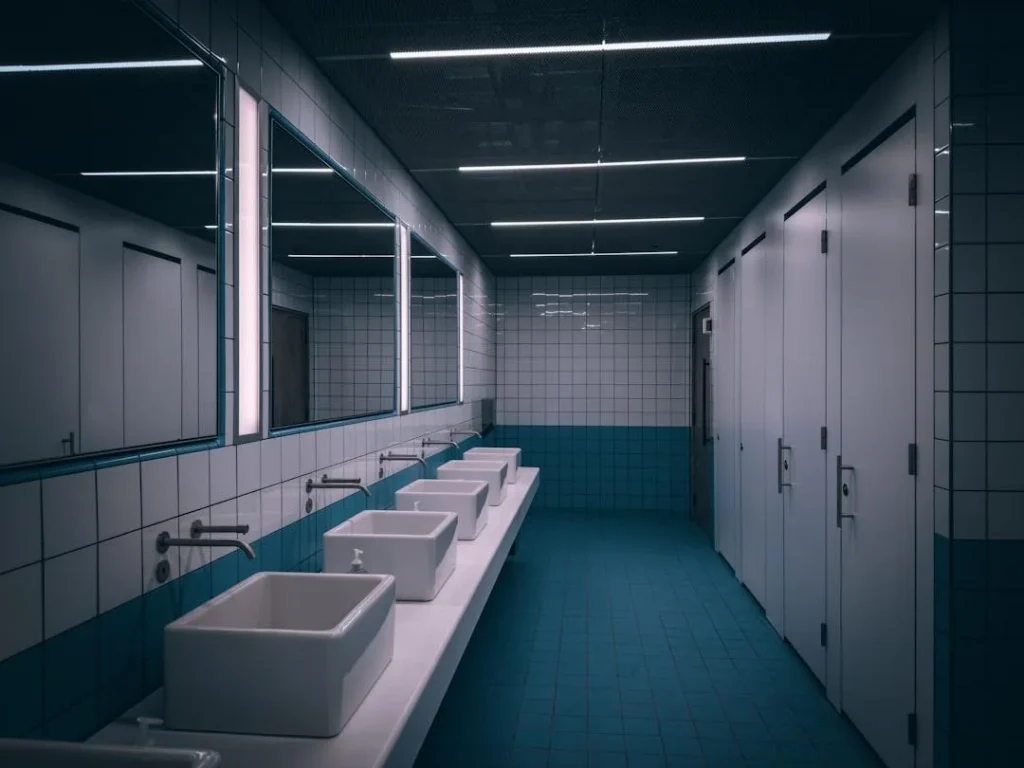
Behavioral health facilities specify washroom accessories against a risk profile that no other building type shares, where standard commercial products can introduce hazards rather than serving occupants (The Joint Commission). The specification logic differs fundamentally from general healthcare construction.
Why Standard Products Create Risk
Conventional washroom accessories include projections, gaps, and hardware that present ligature risk in behavioral health settings. Grab bars, dispensers, and hooks all require redesign rather than simple substitution to serve these environments safely.
What Ligature Resistant Design Actually Changes
Ligature resistant products eliminate points where cord or fabric can be secured, using sloped surfaces, continuous mounting, and breakaway hardware. The design objective is removing attachment points rather than adding strength.
How Accessibility and Safety Requirements Interact
Behavioral health washrooms must satisfy accessibility requirements and safety requirements simultaneously, and the two occasionally pull in different directions. Grab bars are the clearest example, since accessibility requires them and conventional designs create risk.
Where Specialized Product Lines Resolve the Conflict
Resolving that conflict requires purpose-built products, and healthcare washroom accessory lines include ligature resistant grab bars, dispensers, and mirrors engineered to satisfy accessibility dimensional requirements while eliminating the attachment points standard commercial products present (American Specialties, Inc.).
Which Accessory Categories Require Substitution
Four accessory categories consistently require behavioral health specific versions rather than standard commercial products.
- Grab bars using sloped continuous profiles without gaps
- Mirrors using polished stainless rather than breakable glass
- Dispensers with tamper resistant, fully enclosed housings
- Hooks and shelving designed to release under applied load
How Risk Assessment Determines Specification Level
Not every area of a behavioral health facility carries identical risk, and specification should follow a documented assessment rather than applying maximum restriction uniformly (Facility Guidelines Institute). Patient room washrooms typically carry the highest requirements.
Why Uniform Maximum Restriction Backfires
Applying the highest restriction level throughout a facility raises cost and degrades the environment in areas where the risk does not exist. Graduated specification serves both safety and the therapeutic environment.
What Durability Requirements Add
Behavioral health environments experience impact and tampering rates well above typical healthcare settings. Products must resist deliberate damage while avoiding the reinforcement that would create new attachment points.
How That Constraint Shapes Material Choice
Heavy gauge stainless with continuous welded construction addresses both requirements at once. It resists impact without adding the fasteners and gaps that conventional reinforcement introduces.
How Sightline Design Supports Supervision
Behavioral health washrooms balance occupant privacy against staff observation requirements. Partition and accessory layout should support the observation protocol the facility actually uses rather than being resolved on privacy grounds alone.
How Product Documentation Supports Review
Behavioral health projects undergo review by clinical staff and risk managers in addition to standard design review. Products with documented ligature resistance testing move through that process considerably faster than those relying on descriptive claims.
Why Descriptive Claims Are Insufficient
The phrase ligature resistant carries no standardized definition, so documentation of the specific design features and testing matters more than the label. Reviewers evaluate geometry rather than terminology.
Why Clinical Staff Input Shapes Final Selection
Nursing and security staff identify practical failure modes that design review misses, since they observe how units are actually tested by patients. Involving them before selection produces fewer post-occupancy replacements.
What Fastener Selection Contributes
Tamper resistant fasteners prevent disassembly that would expose attachment points or create improvised tools (National Institute of Corrections). Fastener specification deserves the same attention as the product itself, since an accessible fastener defeats an otherwise sound design.
How Maintenance Access Is Preserved
Staff still need to service these units, so tamper resistant systems use specialized tools rather than permanent fastening. Controlling tool access becomes an operational security matter for the facility.
How Documentation Should Follow the Building
Behavioral health facilities change staff and administrators over time while the fixtures remain. Recording what was specified and why preserves the reasoning for the next renovation.
How Staff Training Supports the Specification
Products designed to eliminate risk still depend on staff who understand what to watch for. Training and specification work together rather than substituting for one another.
How Zone-Based Specification Controls Cost
Applying the highest restriction level throughout a facility raises cost and degrades areas where the risk does not exist. Graduated specification serves safety and environment together.
Why Risk Assessment Should Precede Specification
A documented assessment establishes which areas need which level. Without it, specification defaults to maximum restriction everywhere.
How Product Testing Documentation Supports Approval
Clinical reviewers evaluate geometry and testing rather than descriptive claims, since the ligature resistant label carries no standardized definition. Documented testing moves approvals faster than marketing language.
What Reviewers Actually Examine
Reviewers look for attachment points, gaps, and load release behavior. Product data addressing those three directly answers most of the review.
Why Mirror Selection Changes in These Settings
Glass mirrors present breakage and fragment risk that behavioral health environments cannot accept. Polished stainless surfaces trade reflection quality for the elimination of that risk entirely.
How Reflection Quality Affects the Environment
Poor reflection contributes to an institutional feel that works against a therapeutic setting. Higher grade stainless finishes narrow that gap meaningfully.
What Anchoring Requires in High Risk Areas
Accessories in these environments must resist deliberate removal, which places load on the wall assembly rather than the product. Backing and anchoring deserve the same scrutiny as the product specification.
Why Wall Construction Should Be Specified Together
Reinforced wall construction behind accessories is part of the same design decision. Specifying the product without the substrate leaves the weakest element unaddressed.
How Fixture Selection Interacts With Accessory Choice
Behavioral health washrooms specify fixtures and accessories against the same risk framework, and a compliant accessory paired with a conventional fixture leaves the risk in place. The room has to be evaluated as a whole.
Why Piecemeal Substitution Falls Short
Replacing only the accessories in an otherwise conventional washroom addresses part of the exposure. Comprehensive specification produces a materially different result than selective upgrading.
What Sloped Surfaces Accomplish
Sloped tops on dispensers and shelving prevent items from being placed or secured on them. The geometry serves a specific function rather than an aesthetic one, which is worth explaining to reviewers unfamiliar with the category.
How Slope Angle Affects Effectiveness
Shallow slopes still permit placement while steeper ones do not. Product data should state the angle rather than describing the surface generically.
Why Fastener Access Requires a Policy
Tamper resistant fasteners only work while the required tools remain controlled. Facilities need a documented custody procedure rather than treating tool control as an assumption.
What Happens Without Tool Control
Tools distributed widely during installation and never recovered leave the tamper resistance nominal. The hardware performs as specified only while access to it is managed.
How Staff Observation Informs Ongoing Specification
Frontline staff see how patients interact with fixtures in ways that design review cannot anticipate. Facilities that collect those observations improve specification across successive projects.
Why Feedback Should Reach the Specifier
Observations that stay within clinical operations never influence the next building. A route back to the design team converts experience into better specification.
The Specification Principle
Behavioral health washroom specification inverts the usual logic, where the goal is removing capability rather than adding it. Products must do less, not more, while still satisfying every accessibility requirement that applies.